MODERN KAZAKHSTAN
Modern Kazakhstan is a dynamically developing country where socio-economic and environmental processes are closely interconnected.
Cartographic analysis makes it possible to visually illustrate regional differences, identify development patterns, and assess the quality of life of the population.
Below are the main thematic maps created based on statistical data from 2022–2024.
Each map reflects a specific aspect of sustainable development — from demography and employment to ecology and social infrastructure.
Cartographic analysis makes it possible to visually illustrate regional differences, identify development patterns, and assess the quality of life of the population.
Below are the main thematic maps created based on statistical data from 2022–2024.
Each map reflects a specific aspect of sustainable development — from demography and employment to ecology and social infrastructure.
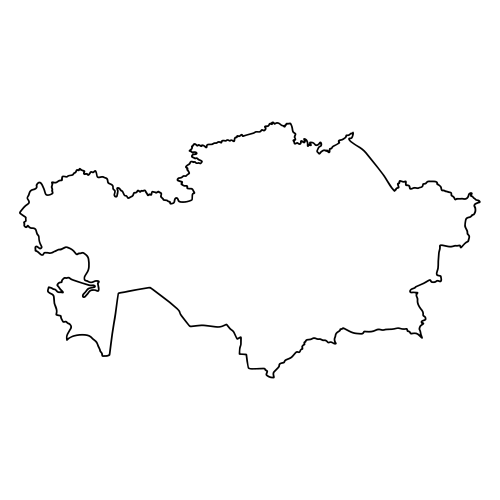

Shows the population distribution by region of Kazakhstan. Allows you to identify the largest centers of urbanization and demographic growth.

Represents the difference between birth and death rates.
The maps highlight regions with positive and negative natural population growth.
The maps highlight regions with positive and negative natural population growth.

Shows the inflow and outflow of population between regions.
It is particularly important for assessing internal migration to megacities and border areas.
It is particularly important for assessing internal migration to megacities and border areas.

Shows territorial differences in health levels and quality of life.
Helps identify regions with the highest social resilience.
Helps identify regions with the highest social resilience.

Shows child mortality rates, reflecting the effectiveness of the healthcare and social welfare systems.

Allows assessing the economic activity of the population and differences in employment across regions.

Reflects differences in income levels and the degree of economic well-being across the regions of the country.

Shows territorial differences in the cost of the basic standard of living.
Allows comparing the level of population well-being across different regions.
Allows comparing the level of population well-being across different regions.

Reflects the degree of social vulnerability of the population.
The map helps identify regions where stronger support measures are needed.
The map helps identify regions where stronger support measures are needed.

Shows the average housing area per person and the development of residential infrastructure.

Displays the structure and volume of the housing stock by region.
Can be used to analyze the quality of urban development.
Can be used to analyze the quality of urban development.

Indicates the level of access to medical care and the development of the healthcare system.

Describes the staffing level of the healthcare system and regional disparities.

Shows the number of nurses and paramedics per 10,000 inhabitants.
It serves as an indicator of the stability of the medical infrastructure.
It serves as an indicator of the stability of the medical infrastructure.

Indicates the level of motorization, which is linked to income levels and the development of transportation infrastructure.

Displays the environmental burden across regions.
Helps identify industrial areas with high levels of pollution.
Helps identify industrial areas with high levels of pollution.
